
Unit Price Math: The Grocery Shelf Label Skill That Actually Saves Money
Learn how to read unit price labels accurately and use them to make smarter grocery comparisons every shopping trip.
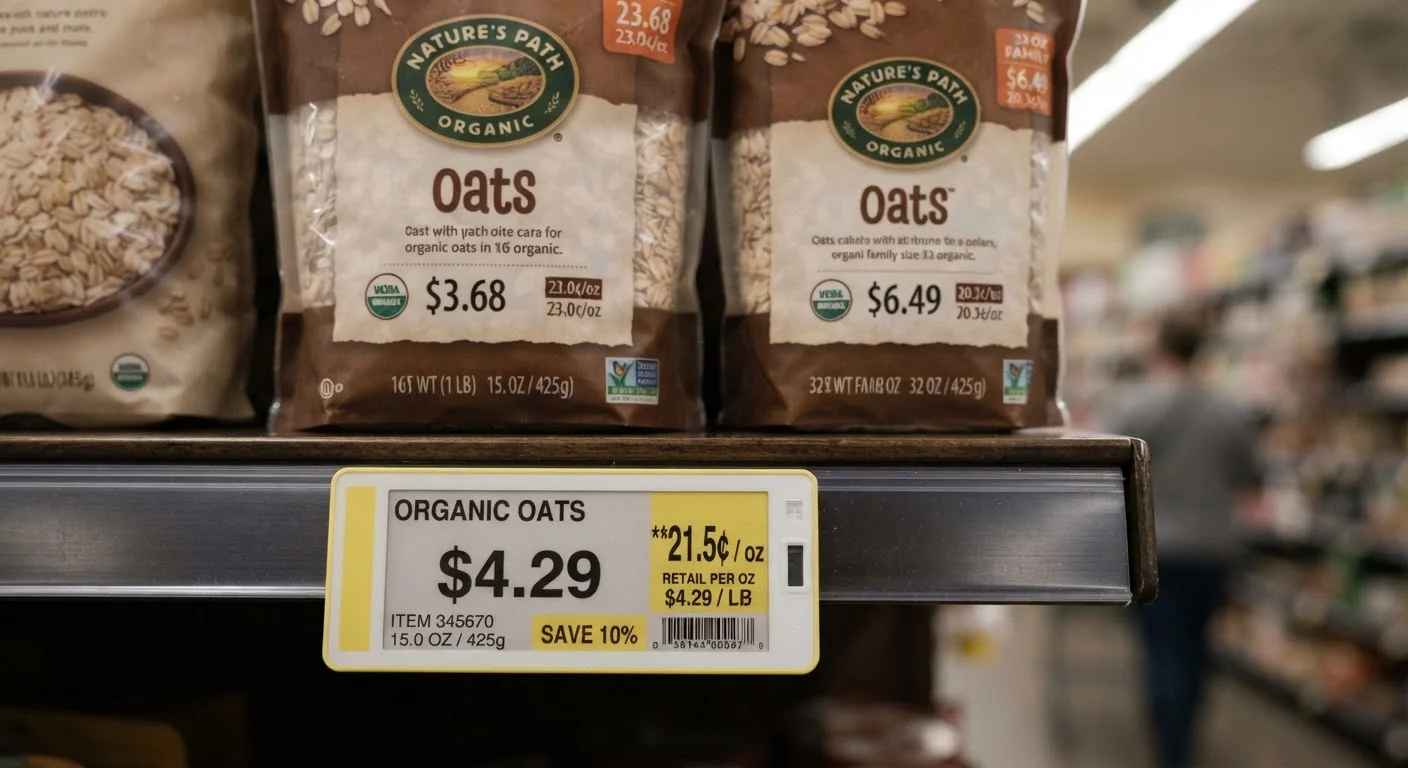
Photo: everythingtoday.com editorial
—— In This Article
Key Takeaways
- Unit price tells you what a product costs per ounce, count, or other standard measure, not per package.
- Bigger packages do not always have a lower unit price than smaller ones.
- Store brands and name brands can be compared directly using unit price math.
- Sale tags do not always produce the lowest unit price on the shelf.
- Checking the unit of measurement is essential because two labels may use different ones.
What the shelf label is actually showing you
Every grocery shelf tag carries two prices. The large number is the total package price. The small number, usually tucked into a corner, is the unit price. That second number does the comparison work for you: it reduces every product on the shelf to the same denominator so you can see at a glance which option costs less per ounce, per count, or per fluid ounce.
Without the unit price, your eye naturally gravitates to the package price, which is exactly what a retailer's merchandising layout encourages. A 32-oz bottle priced at $3.49 looks cheaper than a 16-oz bottle at $1.99 because the dollar figure is larger. The unit prices tell a different story: the larger bottle costs about 10.9 cents per ounce, while the smaller one costs 12.4 cents per ounce. That comparison is impossible to make reliably in your head at shopping speed without the per-unit figure.
For more on how retail pricing can obscure real value, see common retail pricing myths that catch shoppers off guard.
How to calculate unit price when the label is missing
The formula is straightforward: divide the package price by the quantity inside. If a bag of rice weighs 5 pounds and costs $4.79, the unit price per pound is $4.79 divided by 5, which is about 96 cents per pound. The same logic applies to counts: a box of 48 trash bags at $11.52 works out to 24 cents per bag.
The one step that trips people up is unit mismatches. A store-brand pasta may list its unit price per ounce while the name-brand sitting next to it shows per pound. Sixteen ounces equal one pound, so multiply the per-ounce figure by 16 to convert before you compare. Your phone's calculator handles these conversions quickly; there is no need to do it in your head.
Check the unit of measure first
Before comparing two unit prices, confirm both labels use the same measurement. One tag might show cents per ounce while the other shows cents per pound. A quick conversion prevents a misleading comparison and takes less than a minute with a phone calculator.
When comparing products in different categories, such as liquid versus powder detergent, the unit measure changes because one is sold by volume and the other by weight. In those cases, unit price is less useful for direct comparison; load count or number of washes is a more accurate denominator.
When a lower unit price is not the right choice
Unit price math works cleanly for shelf-stable goods: rice, canned beans, dish soap, toilet paper. It gets more complicated with perishables. A 5-pound bag of salad greens may have a lower unit price than a 1-pound bag, but if three pounds end up in the compost bin, you have not saved anything. The real cost per usable ounce is higher than the label suggests.
Storage space has a cost too. Buying a case of something because the unit price is attractive only pays off if you have somewhere to put it and will actually use it. That calculus is different for a family of six in a house with a pantry than for a couple in a small apartment.
For a fuller look at why bulk quantities do not always pencil out, see why bulk buying saves some families nothing. And if you want to build a grocery budget that accounts for these trade-offs week over week, building a family grocery budget covers the structure in detail.
50+
States or jurisdictions with unit pricing laws
A number of U.S. states have enacted unit pricing requirements for grocery retailers, though exemptions for store size and product type vary widely by state law.
~10-30%
Typical unit price variation within a single product category
Consumer research has generally found that unit prices within a single grocery category, such as cooking oil or breakfast cereal, can vary substantially across package sizes and brands on the same shelf.
Putting unit price math into a regular shopping habit
The skill becomes fast with practice. At the shelf, glance at the unit price corner of each tag rather than the package price. When two options are close, pull out the calculator. When one is clearly lower and the package size fits your household's consumption rate, the decision is straightforward.
Sale tags deserve the same scrutiny. A 'sale' price does not automatically produce the lowest unit price in that aisle. A competing brand at full price sometimes undercuts the sale unit price of a different product. Checking the unit figure on both takes about ten seconds and removes the guesswork entirely.
Unit price reading pairs well with label literacy more broadly. Reading a nutrition label gives you the ingredient and nutritional side of the same comparison, so you can weigh cost and content together. And if you want to understand which shopping patterns quietly push costs up over time, shopping habits that inflate monthly spending is worth a look.
Frequently Asked Questions

Shopping Editorial Team
Shopping Editorial Team is the collective byline for our editorial team and contributor network. Articles published under this byline or an editorial pen name are researched, written, and reviewed according to our editorial standards for clarity, consistency, and independence before publication.
View author profile